
Work, Energy, and Power
Students calculate work, kinetic energy, gravitational potential energy, and power while tracking energy changes within a system.
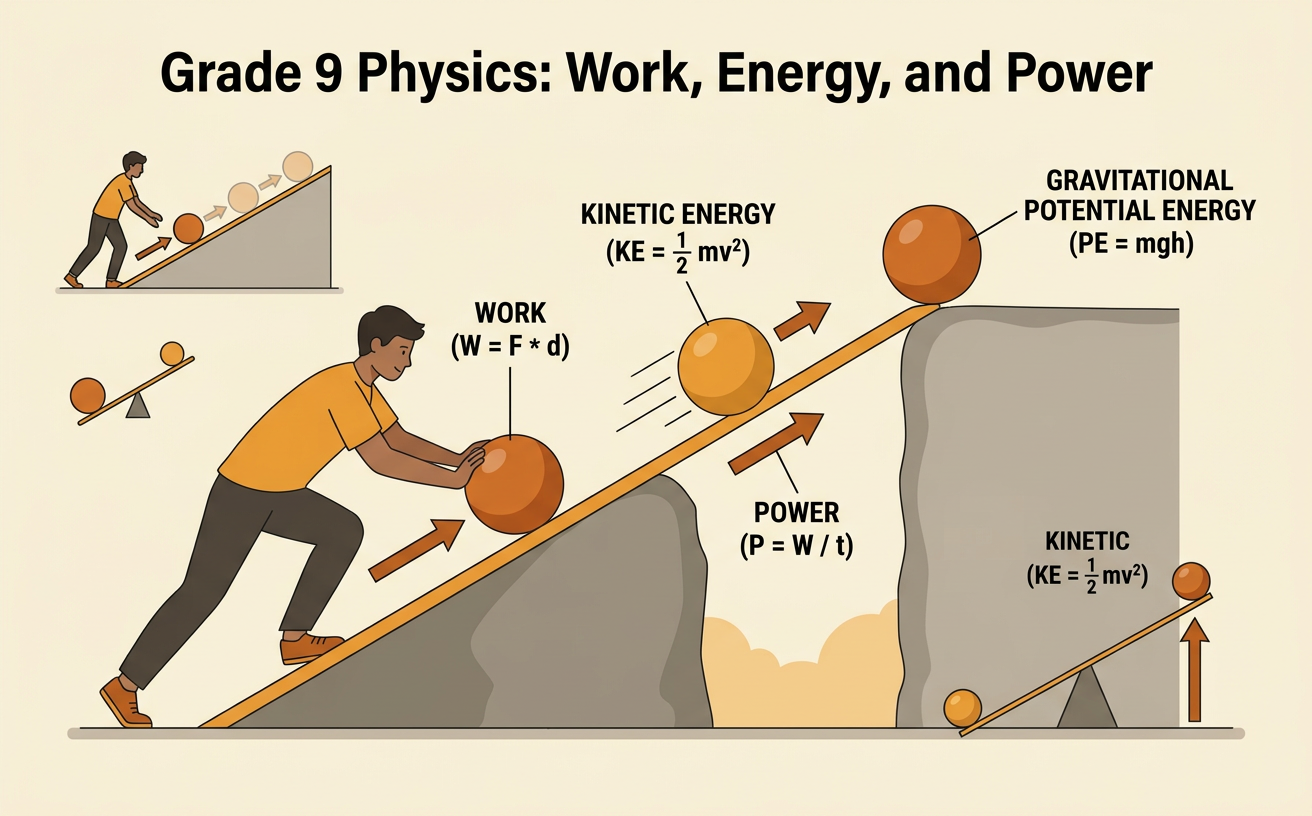
Illustrations are auto-generated and may be placeholders. They can be refreshed to match the narration.
Work and Force
Work is the transfer of energy that occurs when a force causes an object to move through a displacement. For a constant force, work is calculated with W = Fd cos θ, where F is force in newtons, d is displacement in meters, and θ is the angle between the force and displacement. Work is measured in joules, and one joule equals one newton-meter. If a student pushes a box with a 40-newton horizontal force for 3 meters in the same direction, the work done by the student is W = (40 N)(3 m) = 120 J. A force perpendicular to motion does no work because cos 90° = 0. Work can be positive when energy enters an object or negative when a force, such as friction, removes energy from it.
Kinetic Energy
Kinetic energy is the energy an object has because it is moving. It depends on both mass and speed and is calculated with KE = 1/2 mv². Mass must be in kilograms and speed in meters per second, giving kinetic energy in joules. A 2-kilogram cart moving at 5 meters per second has KE = 1/2(2 kg)(5 m/s)² = 25 J. Because speed is squared, doubling the cart's speed would make its kinetic energy four times as large. The work-energy relationship states that the net work done on an object equals its change in kinetic energy: Wnet = ΔKE. Therefore, a positive net work of 25 joules adds 25 joules of kinetic energy, while negative net work reduces the object's kinetic energy.
Potential Energy
Potential energy is stored energy associated with the position or arrangement of parts of a system. Near Earth's surface, gravitational potential energy is calculated with PEg = mgh, where m is mass, g is gravitational field strength, and h is height above a chosen reference level. Using g = 9.8 m/s², a 10-kilogram backpack on a shelf 2 meters above the floor has PEg = (10 kg)(9.8 m/s²)(2 m) = 196 J relative to the floor. Raising the backpack transfers energy into the Earth-backpack system. If the backpack falls, gravitational potential energy decreases while kinetic energy increases. The selected reference level matters because height is measured from it, but changes in potential energy remain consistent when the same reference is used throughout a calculation.
Conservation of Energy
Energy is conserved: it cannot be created or destroyed, but it can move into or out of a system and change form. A computational model tracks each energy component with Einitial + Ein = Efinal + Eout. Consider a 50-kilogram roller coaster car starting from rest 10 meters above a reference level. Its initial gravitational potential energy is (50 kg)(9.8 m/s²)(10 m) = 4,900 J. At a height of 6 meters, it has 2,940 J of potential energy. If friction is ignored, the remaining 1,960 J must be kinetic energy, so the system still contains 4,900 J total. In a real coaster, some mechanical energy becomes thermal energy and sound. Including those outputs keeps the total energy account balanced even when the car's mechanical energy decreases.
Calculating Power
Power measures how quickly work is done or energy is transferred. Average power is calculated with P = W/t or P = ΔE/t, where work or energy is measured in joules and time is measured in seconds. The unit of power is the watt, and one watt equals one joule per second. Suppose a motor does 600 joules of work lifting a load in 3 seconds. Its average power is P = 600 J ÷ 3 s = 200 W. Another motor that performs the same 600 joules of work in 6 seconds produces only 100 watts. Both motors transfer the same amount of energy, but the first transfers it faster. Power describes the rate of energy transfer, not the total energy transferred.