
Writing a Complete Narrative
Students create a narrative with an established situation, sequenced events, dialogue or description, temporal words, and a clear ending.
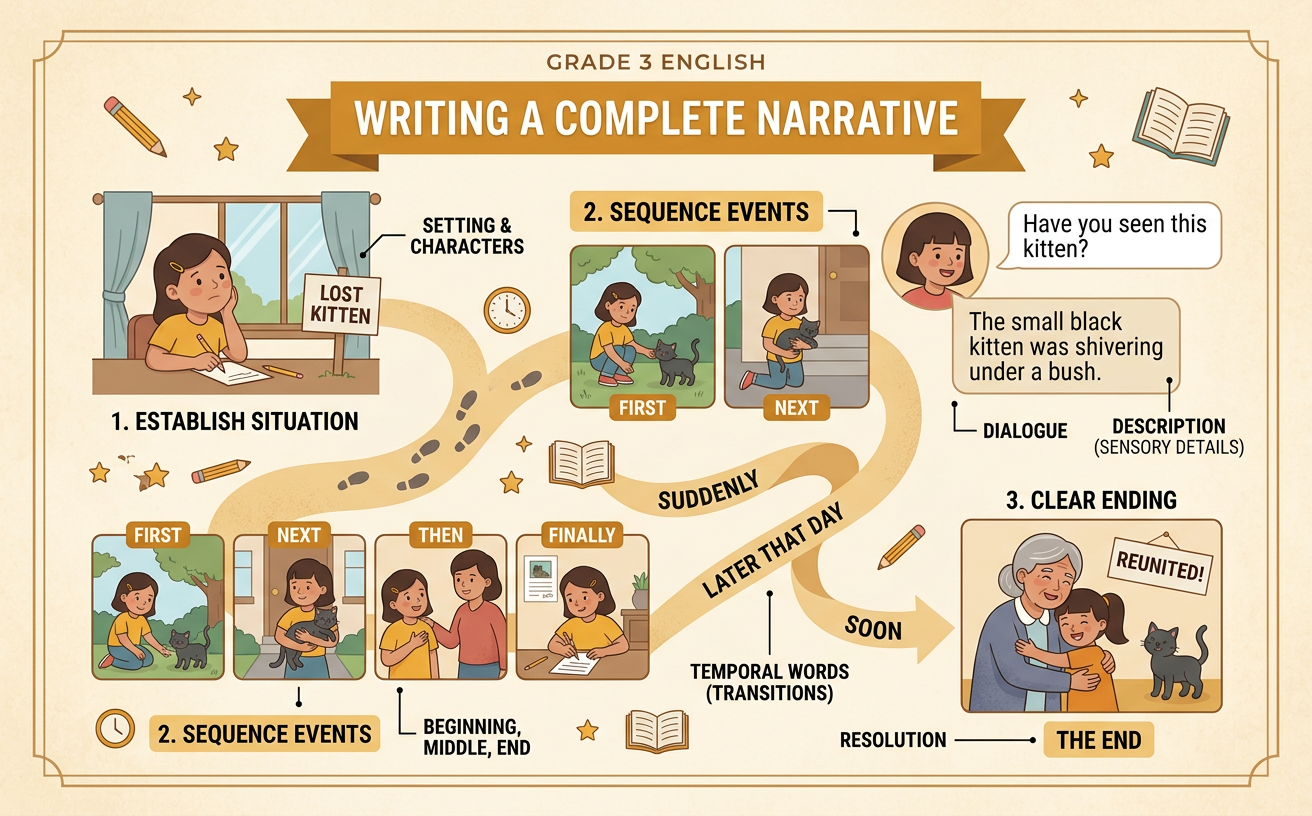
Illustrations are auto-generated and may be placeholders. They can be refreshed to match the narration.
Plan the Situation and Characters
Before writing, decide who is in the story and where and when it happens. The person telling the story is the narrator. The narrator may also be a character. Give the main character a goal, problem, or reason to act. These details establish the situation and help readers understand what is happening. For example, Maya is the narrator and main character. On a rainy Saturday morning, she enters her school’s science fair. She wants to demonstrate her model volcano, but she discovers that she left the baking soda at home. This plan introduces the character, setting, and problem. As you plan, ask: Who is telling the story? Who else is involved? Where and when does it happen? What does the main character want or need?
Sequence the Events
A narrative needs events in an order that makes sense. Plan a beginning, middle, and end before you draft. In the beginning, introduce the situation and problem. In the middle, show the character trying to solve the problem. In the end, explain what finally happens. Each event should lead naturally to the next one. For example, Maya notices that her baking soda is missing. She asks her teacher for help. Then her friend Leo remembers that the classroom supply cabinet contains baking soda. They find it and prepare the volcano. Finally, Maya completes her demonstration. Do not jump from the problem to the solution without showing the steps between them. A sequence chart can help you check that no important event is missing or out of order.
Add Dialogue and Description
Dialogue shows the exact words characters say. Put quotation marks around spoken words, and use a comma to separate the speech from a dialogue tag when needed. For example, Maya asked, “Do we have any baking soda?” Dialogue can reveal a character’s thoughts or move the action forward. Description tells about actions, thoughts, feelings, and sensory details. Instead of writing, “Maya was nervous,” try, “Maya’s hands trembled as the judges approached her table.” This description helps readers picture her actions and understand her feelings. Choose details that matter to the story rather than describing everything. You can combine dialogue and description: Leo opened the cabinet and smiled. “Here it is!” he called. Together, dialogue and description make characters and events feel real.
Use Temporal Words
Temporal words and phrases tell when events happen and show their order. They guide readers smoothly through the narrative. Words such as first, next, then, later, after that, and finally can connect events. For example: “First, Maya searched under the table. Next, she asked her teacher for help. A few minutes later, Leo found the baking soda. Finally, the volcano erupted with a foamy splash.” The temporal phrases make the order easy to follow. You do not need to begin every sentence with a temporal word. Use them where readers need help understanding a change in time. You can also use phrases such as that morning, while the judges waited, or before the demonstration began. Choose each word or phrase to match the timing of the event.
Create a Clear Ending
A narrative needs an ending that provides a sense of closure. The ending should show how the main problem turns out and how the character responds. Do not stop immediately after the most exciting event. Add a final action, thought, feeling, or lesson that helps the story feel complete. For example: “The volcano bubbled over the sides of the model. The judges applauded, and Maya let out a relieved breath. She thanked Leo for helping and decided to make a supply checklist before her next project.” This ending resolves the missing-supplies problem and tells how Maya feels afterward. Avoid endings that introduce a new, unrelated problem. Ask yourself: Is the main problem resolved? Does the reader know what happens to the character? Does the final sentence fit the events of the story?
Revise the Narrative
Revising means improving your ideas and organization, not just correcting spelling. Read your draft aloud and listen for places that are confusing, rushed, or missing details. Check that the beginning establishes the situation and introduces the narrator or characters. Make sure the events are in order, dialogue is punctuated clearly, descriptions show important actions and feelings, and temporal words guide the reader. Then check that the ending provides closure. For example, revise “Maya got help. The volcano worked” to “After Maya asked for help, Leo found baking soda in the supply cabinet. Finally, the volcano erupted, and Maya grinned with relief.” The revised version explains the events and shows a feeling. Last, edit capitalization, punctuation, grammar, and spelling so readers can understand your finished narrative.