
Writing a Narrative with Clear Sequence and Details
Students plan and write a short narrative that develops events in a logical order using descriptive details, dialogue, and transitions.
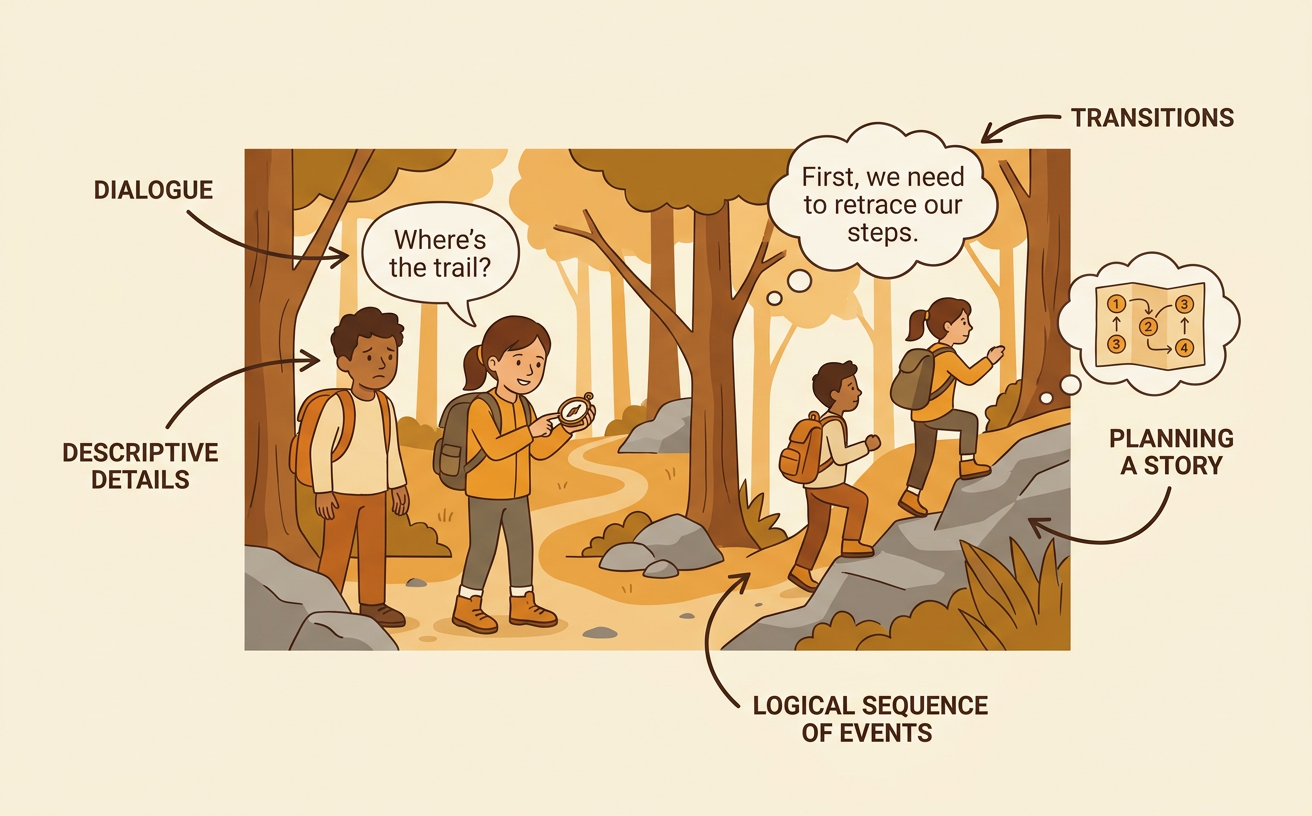
Illustrations are auto-generated and may be placeholders. They can be refreshed to match the narration.
Identify the Parts of a Narrative
A narrative is a story about an experience or event. Most narratives have a beginning, middle, and end. In the beginning, introduce the characters and setting. Also explain the main situation or problem. In the middle, develop the action by showing what the characters do, think, and feel. The characters may face a challenge or make an important decision. In the end, show how the situation is resolved and what happens afterward. For example, a story might begin with Ava losing her dog at the park. In the middle, she searches the playground and asks people for help. At the end, Ava hears barking near the pond and finds her dog tangled in a bush. Each part helps the reader understand and enjoy the complete story.

Choose a Narrator and Situation
Before writing, decide who will tell the story and what situation will occur. A first-person narrator is a character in the story and uses words such as I, me, and my. A third-person narrator is outside the story and uses names or words such as he, she, and they. Keep the narrator consistent so readers know whose point of view they are following. Then choose a clear situation that gives the character a goal, problem, or surprise. For example, a first-person story could begin, “I stepped onto the stage and suddenly forgot my first line.” The narrator is the student performing, and the situation is forgetting a line during a play. This situation can lead to actions, feelings, dialogue, and a solution as the story develops.

Sequence the Events
Put events in a logical order so readers can easily follow what happens. First, list the important actions from the opening event to the solution. Remove events that do not help develop the story, and add steps if the action seems to jump too quickly. Use transition words and phrases to show time and order, such as first, next, a few minutes later, meanwhile, after that, and finally. For example, a student might plan these events: First, Leo notices that his science project is missing. Next, he checks his backpack and classroom shelf. A few minutes later, his friend remembers seeing the project in the library. Finally, Leo finds it beside a computer. This sequence makes sense because each event leads naturally to the next one. A timeline or event organizer can help you check the order before drafting.

Add Dialogue and Sensory Details
Dialogue and sensory details make a narrative feel real. Dialogue shows the exact words characters say and can reveal feelings, share information, or move the action forward. Place quotation marks around a speaker’s words. Start a new paragraph when a different character speaks. Sensory details describe what characters see, hear, smell, taste, or touch. Instead of writing, “The storm was scary,” write, “Thunder cracked above us, cold rain stung my cheeks, and wet leaves slid under my shoes.” Then add useful dialogue: “We need to get inside!” Maya shouted. These details help readers imagine the scene and understand Maya’s fear. Choose details that fit the important moment rather than describing everything. Strong details and purposeful dialogue slow down key events and make them more vivid.

Write a Strong Conclusion
A strong conclusion brings the narrative to a satisfying end. It shows how the main situation is resolved and explains the character’s final reaction, thought, or lesson. The ending should connect to earlier events instead of introducing a completely new problem. Avoid stopping suddenly with “The end.” For example, if Jordan has spent the story learning to ride a bicycle, the conclusion might say, “I pushed down on the pedals and rolled all the way to the oak tree without Dad holding the seat. When I turned around, he was cheering. I still wobbled, but now I knew I could keep going.” This ending resolves Jordan’s challenge and shows pride and confidence. Reread your beginning before writing the conclusion so you can connect the final moment to the story’s original goal or problem.
