
Writing a Personal Narrative
Students write and share a short personal narrative with sequenced events, details, time-order words, and a closing.
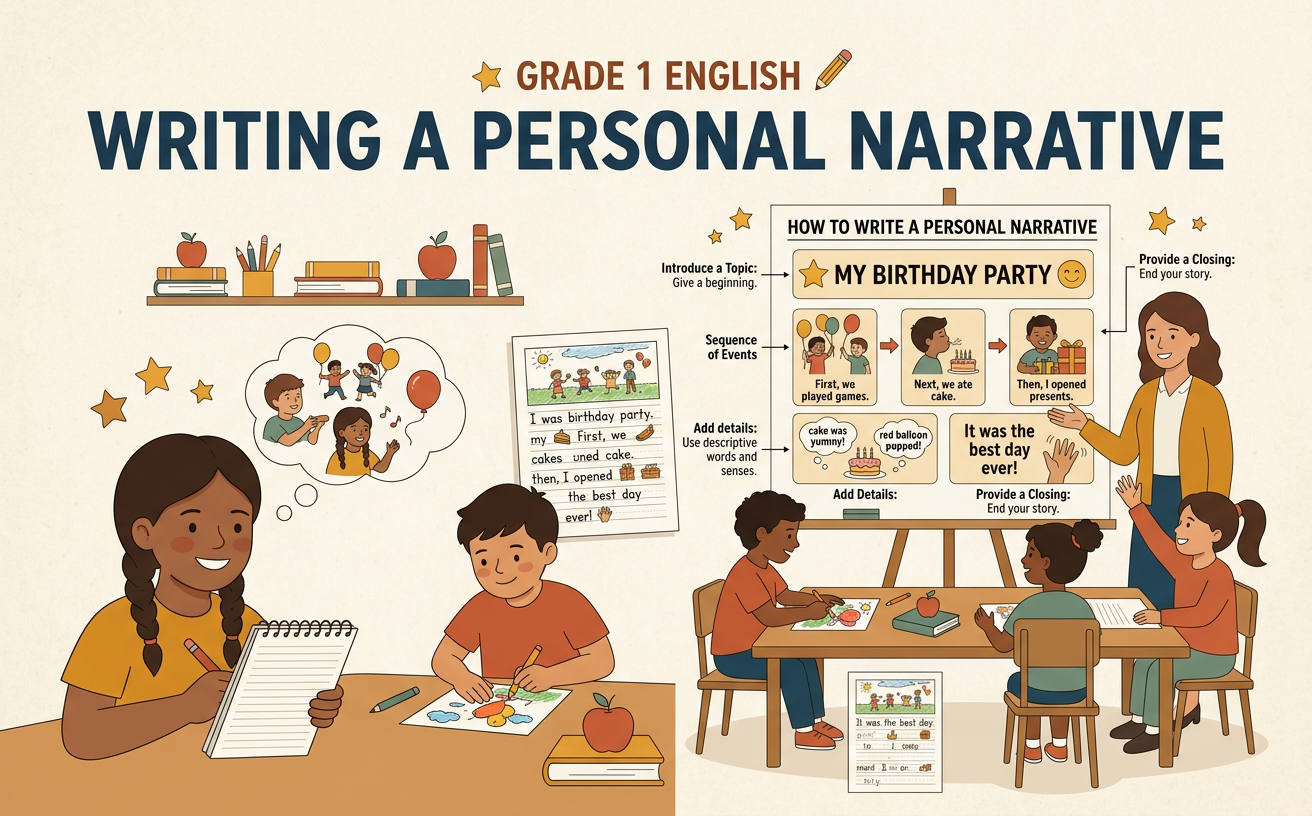
Illustrations are auto-generated and may be placeholders. They can be refreshed to match the narration.
Choose a Small Moment
A personal narrative is a true story about something that happened to you. Begin by choosing one small moment. A small moment does not tell about a whole week, vacation, or school year. It focuses on one short event that you remember well. You might write about losing a tooth, learning to ride a bike, baking cookies, or meeting a new friend. Choose a moment that has a clear beginning, middle, and end. For example, instead of writing about an entire trip to the beach, write about the moment you built a sandcastle and a wave washed it away. Think about who was there, where you were, what happened, and why the moment mattered. Pick an event you can describe with actions, details, and feelings.
Plan the Event Sequence
Before you write, put the events in the order they happened. A narrative should have at least two events, and each event should lead clearly to the next one. Use a beginning, middle, and end plan. In the beginning, tell where you were and what you were doing. In the middle, explain the main actions or problem. At the end, tell what happened last. For example, imagine you planted a seed. First, you filled a pot with soil and pushed in the seed. Next, you watered it and placed it near a sunny window. Later, a green sprout appeared. Draw or write each event in a separate planning box. Then read your plan from left to right. If something seems missing or out of order, move or add an event before you begin writing.
Write with Time-Order Words
Time-order words help readers follow your story from one event to the next. Begin with a word such as first or one morning. Move to the next event with then, next, or after that. Show a later event with later or soon. End with finally or at last. Do not place the words randomly. Choose each word to match when the event happened. Here is an example: “One morning, I took my puppy into the yard. First, I tossed a red ball. Next, Max chased it under a bush. Then, he brought it back to me. Finally, I gave him a treat.” The time-order words make the sequence easy to understand. As you draft, read each sentence and ask, “What happened next?” Add a useful time-order word when the reader needs help moving through the story.
Add Details and Feelings
Details help a reader picture your small moment. Tell what you saw, heard, touched, smelled, or tasted when those details fit the event. You can also include exact actions, spoken words, and feelings. Instead of writing, “I went down the slide,” you could write, “I gripped the cool metal bars, pushed off, and rushed down the tall, twisting slide. ‘I did it!’ I shouted. My heart beat fast, and I felt proud.” The second version shows what the child did, said, sensed, and felt. Add details that belong in your story, but do not add events that did not happen. Try to answer questions such as “What did it look like?” and “How did I feel?” Strong details make a true story lively and clear while keeping the events focused on the same small moment.
Revise and Share
After drafting, revise your narrative to make it complete and easy to follow. Read it aloud slowly. Check that you told two or more events in the correct order. Look for helpful time-order words and details about actions, places, people, or feelings. Make sure the ending gives a sense of closure. A closing can tell what happened last or how you felt. For example, “Finally, Dad helped me stand after my first bike ride. I could not wait to try again.” If your story jumps between events, move a sentence or add a missing step. If a sentence is unclear, add a useful detail. Then check capitals, end marks, and spelling. Share the finished narrative with a partner or the class. Listen to questions and kind comments, and speak loudly enough for everyone to hear.