
Writing a Supported Opinion
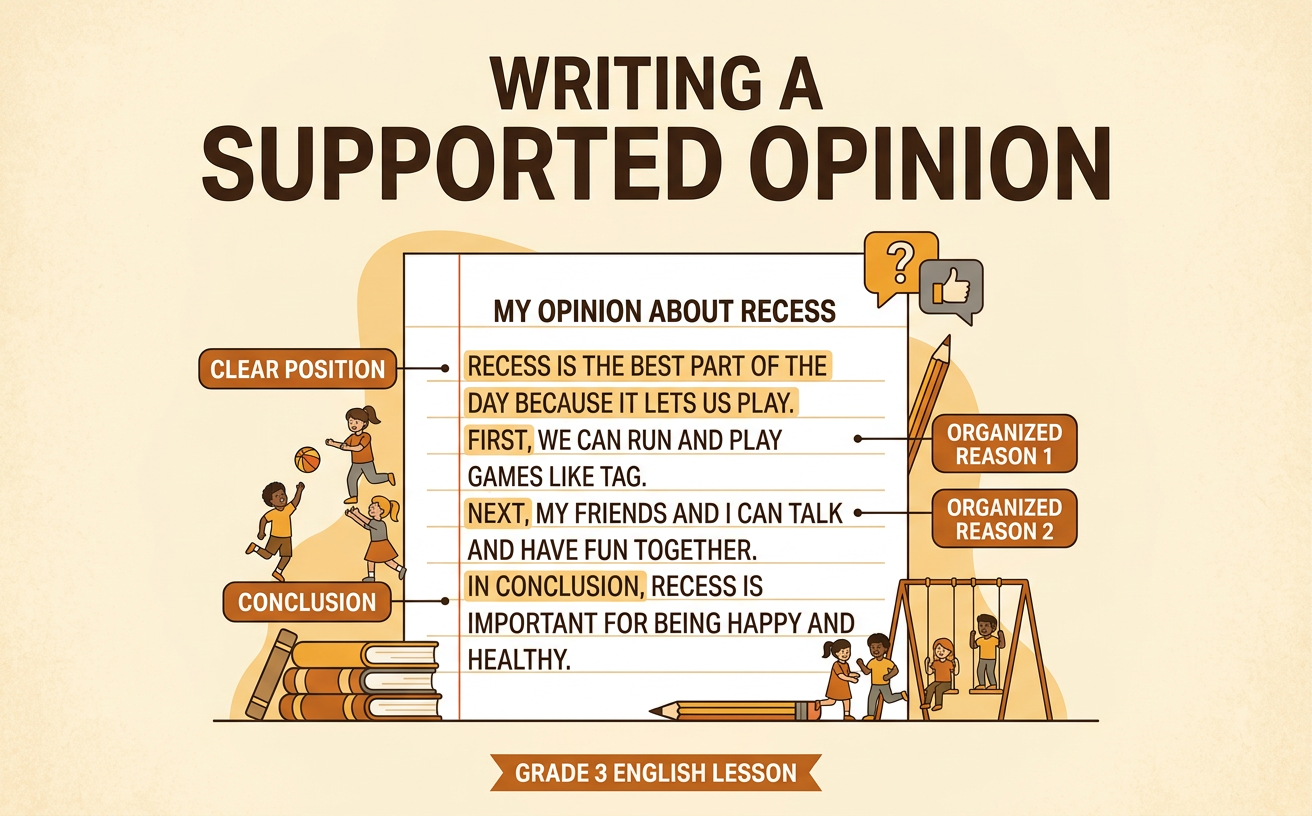
Students write an opinion paragraph that states a clear position and supports it with organized reasons and a conclusion.
Illustrations are auto-generated and may be placeholders. They can be refreshed to match the narration.
Read the Prompt
Before writing, read the prompt slowly and find what it asks you to do. Look for the topic, the choice you must make, and the audience who will read your paragraph. For example, a prompt might say, “Should our class have a longer recess? Write a paragraph to convince your principal.” The topic is recess. You must decide whether recess should be longer, and your audience is the principal. Circle important words such as should, choose, explain, or convince. Then restate the task in your own words: “I need to tell the principal what I think about longer recess and give reasons.” Understanding every part of the prompt helps you stay focused and include the information your reader needs.
State an Opinion
An opinion tells what you think, believe, prefer, or recommend. Begin your paragraph with a clear opinion statement that answers the prompt. Do not make your reader guess your position. For the recess prompt, you could write, “Our class should have a longer recess.” This sentence clearly supports longer recess. You may add a brief preview of your reasons: “Our class should have a longer recess because it helps students exercise, relax, and focus.” Avoid weak openings such as “Recess is a thing at school” because they do not state a position. Also avoid trying to support both choices at once. Choose one position that you can explain with strong reasons, and state it in a respectful, confident way.
Brainstorm Strong Reasons
Reasons explain why your opinion makes sense. Before drafting, brainstorm several possible reasons. Then choose two or three reasons that are different, specific, and connected to your opinion. If your opinion is that recess should be longer, possible reasons include “Students would get more exercise,” “Students could return to class calmer,” and “Students would have more time to practice teamwork.” Add a detail or example to strengthen each reason. For exercise, you might explain that students can run, climb, or play active games. Do not choose a reason such as “Recess is recess.” It repeats the topic but does not explain why longer recess would help. Ask yourself, “Will this reason help convince my audience?” Strong reasons give your reader useful information instead of simply repeating your opinion.
Organize the Paragraph
Organize your ideas so the reader can follow your thinking. Start with your opinion sentence. Next, present each reason in a sensible order and explain it with a detail or example. Use linking words to connect your ideas. You might write, “First, a longer recess would give students more exercise. For example, they could run and play active games. Also, extra outdoor time could help students return to class feeling calm and ready to learn.” Each sentence should support the same opinion. Place similar ideas together instead of jumping between topics. A useful paragraph plan is opinion, first reason and detail, next reason and detail, and conclusion. Following this structure makes your persuasive paragraph clear, organized, and easy to understand.
Add a Conclusion
A conclusion is the final sentence or section of your paragraph. It reminds readers of your opinion and gives the writing a finished feeling. Restate your position using new words rather than copying your opening exactly. If your opening says, “Our class should have a longer recess,” your conclusion might say, “For these reasons, adding more recess time would be a healthy and helpful choice for our class.” This conclusion returns to the opinion and connects it to the reasons. You can begin with phrases such as “For these reasons,” “Therefore,” or “That is why.” Do not introduce a completely new reason in the conclusion because you will not have time to explain it. End with a confident sentence that leaves your audience thinking about your position.
Check Persuasive Language
After drafting, reread your paragraph and check whether your words help persuade the audience. Use confident phrases such as “I believe,” “should,” and “would help.” Add linking words such as “because,” “first,” “also,” “for example,” and “therefore” to show how ideas connect. Be respectful, even when you strongly disagree. Write, “A longer recess would help students focus,” instead of “Anyone who dislikes recess is wrong.” Check that every reason supports your opinion and that each example explains a reason. Also check complete sentences, capitals, punctuation, and spelling. Read the paragraph aloud to hear missing or repeated words. Finally, ask, “Did I state my opinion, organize strong reasons, and end with a conclusion?” Revising these parts can make your writing clearer and more convincing.