
Writing and Solving Two-Step Linear Equations
Students translate situations into equations, solve equations with rational coefficients, and verify and interpret their solutions.
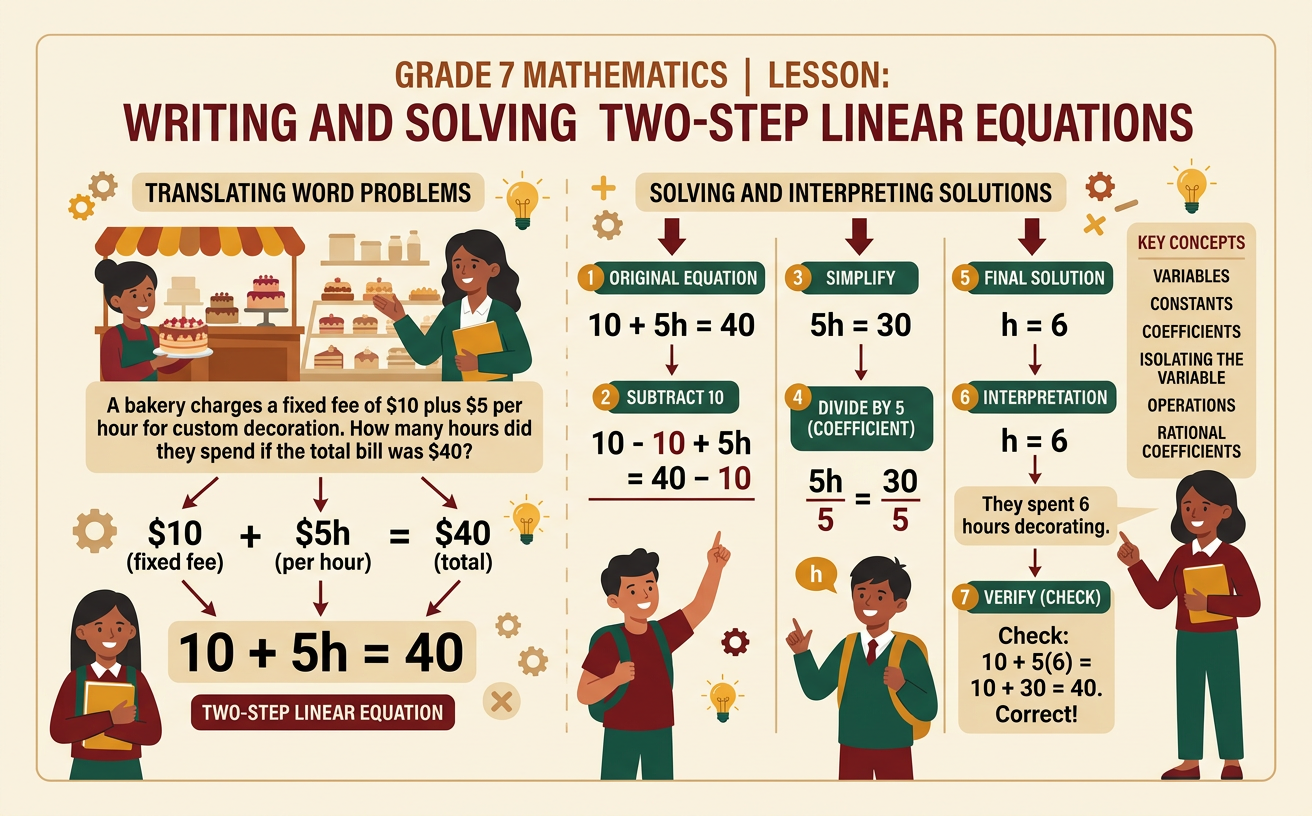
Illustrations are auto-generated and may be placeholders. They can be refreshed to match the narration.
From Expressions to Equations
An expression contains numbers, variables, and operations, while an equation states that two expressions are equal. In 4x + 7, the variable x represents an unknown number, 4 is the coefficient, and 7 is the constant term. The equation 4x + 7 = 31 asks which value of x makes both sides equal. Verbal descriptions can be translated one part at a time. The statement “seven more than four times a number is thirty-one” becomes 4x + 7 = 31. Order matters when translating subtraction and division. For example, “five less than twice a number” means 2x − 5, not 5 − 2x. Defining the variable before writing an equation makes the model clear. Here, let x represent the unknown number.
Using Inverse Operations
Solving an equation means isolating the variable while keeping the equation balanced. Whatever operation is performed on one side must also be performed on the other. To solve 4x + 7 = 31, first subtract 7 from both sides, producing 4x = 24. Then divide both sides by 4, giving x = 6. These steps reverse the original order of operations. The expression first multiplies x by 4 and then adds 7, so solving first subtracts 7 and then divides by 4. Rational numbers are handled in the same way. For example, 2.5x − 3 = 12 becomes 2.5x = 15 after adding 3. Dividing by 2.5 gives x = 6. Keep each equality visible to show that the equation remains balanced.
Solving Equations with Parentheses
Some equations have the form p(x + q) = r. One method is to divide both sides by p before isolating x. For example, 3(x − 4) = 21 can first be divided by 3, giving x − 4 = 7. Adding 4 to both sides produces x = 11. Another method is to distribute: 3x − 12 = 21, followed by adding 12 and dividing by 3. Both methods give the same answer. Choose the method that creates simpler calculations. For −2(x + 5) = 18, dividing both sides by −2 gives x + 5 = −9. Subtracting 5 gives x = −14. Be careful to divide by the entire coefficient, including its negative sign.
Modeling and Checking Real-World Situations
A real-world equation connects an unknown quantity to known information. Suppose a recreation center charges a $12 registration fee plus $8 per class, and a student spends $60. Let c represent the number of classes. The equation is 8c + 12 = 60. Subtracting 12 gives 8c = 48, and dividing by 8 gives c = 6 classes. Check the solution by substituting 6 into the original equation: 8(6) + 12 = 48 + 12 = 60. The result is true, so the solution is correct. The context also matters. A solution of 6 represents six classes, not six dollars. If a calculation produced a negative or fractional number of classes, students should decide whether that answer would be reasonable in the situation.