Writing Arithmetic Sequences Explicitly and Recursively
Students identify common differences and write recursive and explicit rules to model arithmetic sequences.

Illustrations are auto-generated and may be placeholders. They can be refreshed to match the narration.
Recognizing Arithmetic Sequences
An arithmetic sequence is an ordered list of numbers in which the difference between consecutive terms is constant. This constant change is called the common difference. For example, 7, 11, 15, 19, 23 is arithmetic because 4 is added each time. The position of a term matters: 7 is the first term, 11 is the second term, and so on. A sequence does not have to increase. The sequence 20, 17, 14, 11 is arithmetic because 3 is subtracted each time, so its common difference is negative 3. In contrast, 2, 4, 8, 16 is not arithmetic because the differences are 2, 4, and 8, which are not equal. To recognize an arithmetic sequence, compare every pair of consecutive terms and check for one constant difference.

Finding the Common Difference
To find the common difference, subtract any term from the term that follows it. In symbols, d = a_n - a_{n-1}. Consider the sequence 18, 13, 8, 3. Subtract consecutive terms: 13 - 18 = -5, 8 - 13 = -5, and 3 - 8 = -5. Because every result is -5, the common difference is d = -5. The negative sign shows that the sequence decreases by 5 each time. Be careful to subtract in the correct order: later term minus earlier term. For an increasing sequence such as -2, 4, 10, 16, the differences are 6, 6, and 6, so d = 6. Checking more than one pair confirms that the difference is constant and that the sequence is arithmetic.

Writing Recursive Rules
A recursive rule defines each term by using the term immediately before it. A complete recursive rule for an arithmetic sequence must state the first term and explain how to find later terms. For the sequence 5, 8, 11, 14, the first term is a_1 = 5 and the common difference is 3. Its recursive rule is a_1 = 5 and a_n = a_{n-1} + 3 for n greater than or equal to 2. To generate the sequence, begin with 5. Then add 3 to get 8, add 3 again to get 11, and continue. If the common difference is negative, the rule still uses addition. For example, a sequence decreasing by 4 has a_n = a_{n-1} + (−4), which can also be written a_n = a_{n-1} − 4.

Writing Explicit Formulas
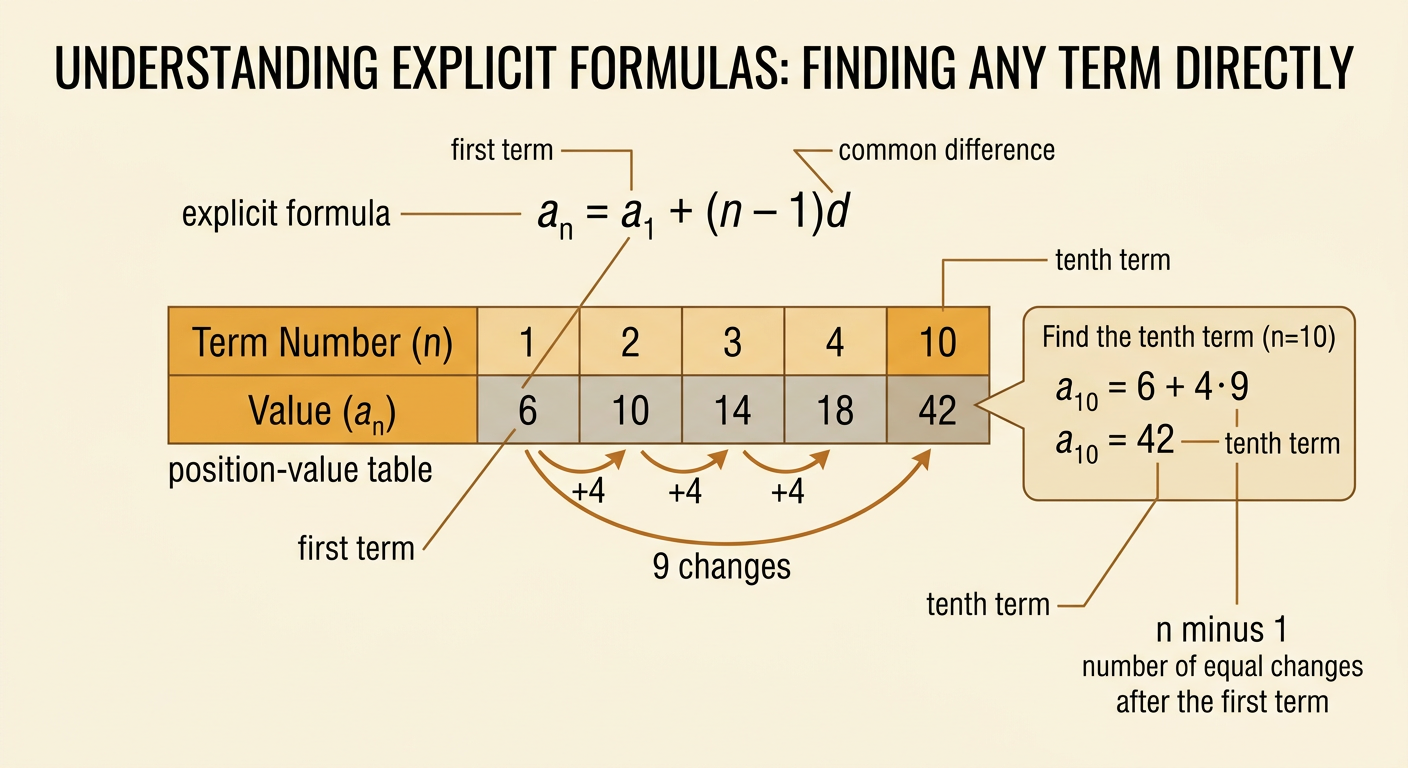
An explicit formula finds any term directly from its position without calculating all earlier terms. For an arithmetic sequence, the formula is a_n = a_1 + (n − 1)d, where a_1 is the first term, d is the common difference, and n is the term number. The factor n − 1 counts how many equal changes occur after the first term. For the sequence 6, 10, 14, 18, the first term is 6 and d = 4. Therefore, a_n = 6 + 4(n − 1). To find the tenth term, substitute n = 10: a_10 = 6 + 4(9) = 42. An equivalent simplified formula is a_n = 4n + 2. Both formulas produce the same terms, but the first form makes the starting value and common difference especially easy to see.
Connecting the Two Forms
Recursive and explicit rules describe the same arithmetic sequence in different ways. The recursive form emphasizes how one term changes into the next, while the explicit form connects each term directly to its position. Suppose a sequence is given recursively by a_1 = 12 and a_n = a_{n-1} − 3. The first term is 12, and the common difference is −3. Substitute these values into the arithmetic sequence formula to get a_n = 12 + (n − 1)(−3), or a_n = 12 − 3(n − 1). To translate in the other direction, examine the explicit rule a_n = 9 + 5(n − 1). It shows a first term of 9 and a common difference of 5, so the recursive rule is a_1 = 9 and a_n = a_{n-1} + 5 for n greater than or equal to 2.

Modeling a Real-World Pattern
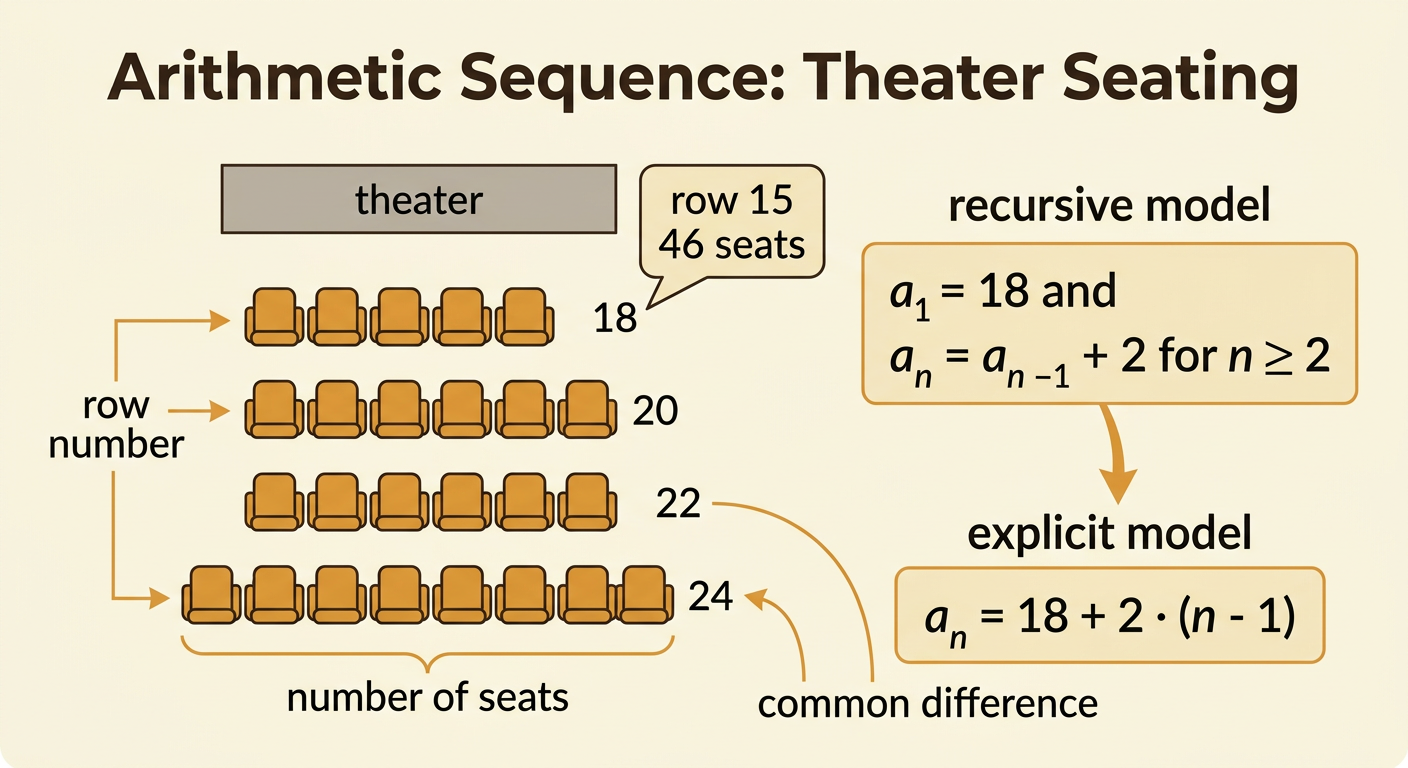
Arithmetic sequences can model situations with a constant increase or decrease. Imagine a theater in which the first row has 18 seats and each row behind it has 2 more seats than the previous row. The numbers of seats form the sequence 18, 20, 22, 24, and so on. A recursive model is a_1 = 18 and a_n = a_{n-1} + 2 for n greater than or equal to 2. This rule describes how the theater is built row by row. An explicit model is a_n = 18 + 2(n − 1). It can find the number of seats in any row directly. For row 15, a_15 = 18 + 2(14) = 46. In this model, n represents the row number, a_n represents the number of seats in that row, and 2 represents the constant increase in seats.