
Young Plants and Parent Plants: Alike but Not Identical
Students compare photographs of parent plants and their young to identify inherited similarities and small differences using visual evidence.

Illustrations are auto-generated and may be placeholders. They can be refreshed to match the narration.
Meet the Parent and Young Plants
Plants begin their lives as young plants. A young plant can grow from a seed made by a parent plant. It often has traits that look like traits on the parent. A trait is a feature we can observe, such as leaf shape, stem color, or flower color. The young plant is not an exact copy of the parent. It may also look different because it is younger and smaller. Imagine a photograph of a tall sunflower beside a photograph of its young plant. Both plants may have green stems and broad leaves, but only the parent may have a large yellow flower. Photographs are helpful sources because we can study visible details. We can ask, “How are the young plant and parent plant alike, and how are they different?”

Look Closely at Plant Traits
Scientists look closely at plant traits instead of only saying that two plants look similar. First, compare the same part on each plant. Look at one leaf on the parent and one leaf on the young plant. Notice each leaf’s shape, edge, color, and vein pattern. Then compare the stems, flowers, or other parts that appear in both photographs. For example, a parent bean plant and a young bean plant may both have wide, oval leaves with branching veins. The parent’s leaves may be darker green. Use careful words such as round, pointed, smooth, wavy, light green, and dark green. Do not guess about a trait that cannot be seen. A clear photograph is a useful source for visible traits, while a blurry or hidden plant part does not provide strong evidence.

Find What Is Alike
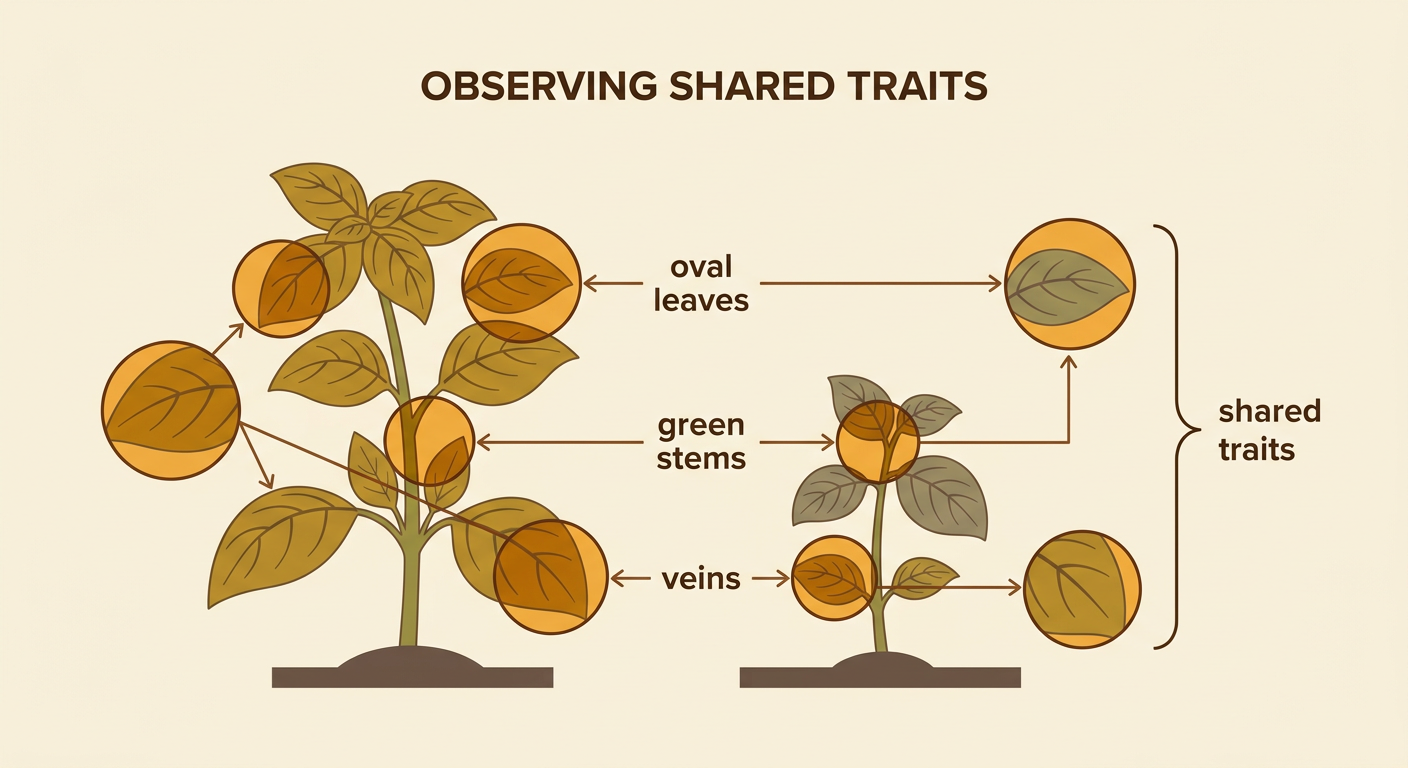
To find similarities, search for traits that appear on both the parent plant and the young plant. Check one trait at a time. Ask, “Do both have this leaf shape? Do both have this stem color? Do both show the same kind of edge?” Point to the photograph when you name your evidence. For example, a parent basil plant and its young plant may both have green stems, oval leaves, and visible lines called veins. These shared traits are evidence that the young plant is like its parent. The plants do not need to be the same size for their leaf shapes to be alike. Make a list or circle matching parts in the photographs. Saying “They are both plants” is true, but naming exact shared traits gives stronger evidence.
Notice What Is Different
Young plants are like their parents, but they are not exactly alike. Look for small differences in size, color, number of leaves, markings, and parts such as flowers. Compare only what the photographs clearly show. For example, a parent coleus plant may have large leaves with dark purple centers. Its young plant may have smaller leaves with lighter purple patches. The smaller size may be related to the plant’s young age. A color difference could come from variation or growing conditions, but a photograph alone cannot tell us the cause. We should say what we observe instead of guessing. A useful observation is, “The parent leaf has a larger dark purple area than the young leaf.” Finding a difference does not mean the plants are unrelated. It shows that offspring are not exact copies of their parents.

Record Evidence in a Picture Chart
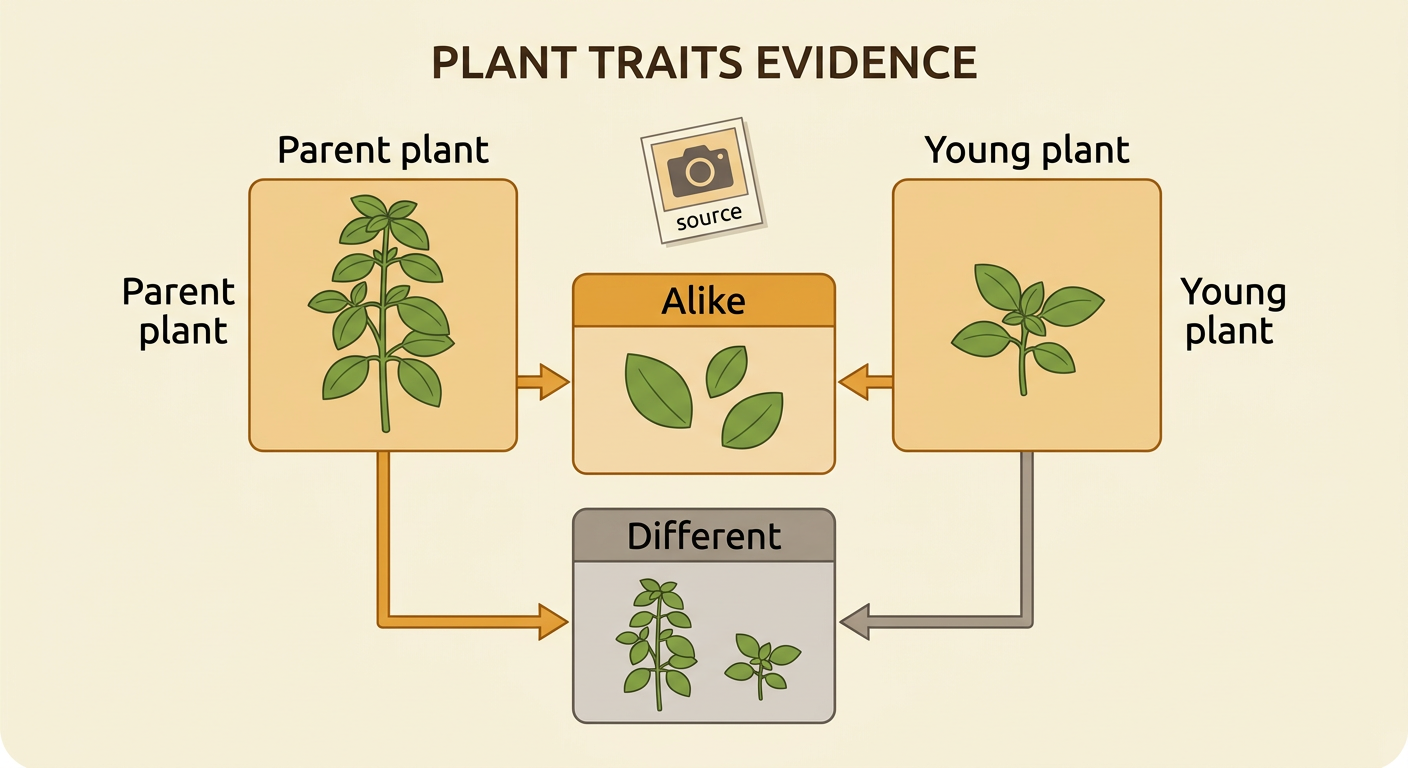
A picture chart helps organize evidence from photographs. With an adult’s help, place or draw the parent plant in one column and the young plant in another. Add a third space for what is alike and a fourth space for what is different. Study the source again before recording each detail. For a basil pair, you might draw oval leaves in the “Alike” space. In the “Different” space, you might draw the tall parent beside the short young plant and write, “The parent has more leaves.” Use labels, short sentences, or dictated words to explain your drawings. Mark the photograph as the source of your information. A clear photograph showing both plants and their parts is more helpful for this question than a picture showing only soil or an empty pot.
Share an Evidence-Based Claim
A claim is an answer to a question. Evidence is what you observed that supports the answer. Use your picture chart and photographs to make a claim about the plants. You can begin, “The young plant is like the parent plant, but it is not exactly the same.” Then add evidence. For example, say, “The young marigold and parent marigold both have green, divided leaves. The parent is taller and has an orange flower, while the young plant has no flower yet.” Show the matching parts in the photographs as you speak. A partner can ask, “What did you see that supports your claim?” Listen to other observations and revise your answer if the source shows new evidence. A strong claim names at least one similarity and one difference that can be seen.
